
Level Up Live Ops: Eid al-Fitr Isn't Just "Another Holiday Event":3 Signals Game Teams Should Check
TL;DR
Eid may bring higher traffic, stronger activity, and better spending intent, but holiday growth is often overestimated when teams focus only on DAU or topline revenue. To understand what is really working, they need to track three things together: whether bundles are converting, whether campaign timing matches actual player behavior during Eid, and whether holiday users stay after the event ends. When these signals are measured as one connected system, Eid becomes more than a short-term revenue spike; it becomes a more reliable live ops opportunity for sustainable growth.
Eid is one of the most important seasonal moments for mobile game teams in Southeast Asia and the Middle East. Player activity usually rises, time spent in game increases, and monetization potential often improves with it. That is why many teams treat Eid as a major live ops opportunity, launching limited-time bundles, refreshing creatives with festive messaging, and pushing campaigns right before the holiday begins.
But strong holiday traffic does not always translate into strong business results. Many games see higher DAU during Eid, yet payment conversion fails to rise at the same pace. Once the holiday ends, activity often drops back quickly, and in some cases retention becomes even weaker than expected. The problem is that many teams focus too much on topline revenue and not enough on what happens in between.
To understand whether an Eid campaign is actually working, three data signals matter most.

Signal 1: Higher Traffic Doesn't Guarantee Higher Bundle Conversion
During Eid, many teams look first at bundle sales or GMV. But those numbers can be misleading in a holiday period, when traffic is already higher than usual. What matters more is whether players who see the offer actually move through the purchase funnel and convert.
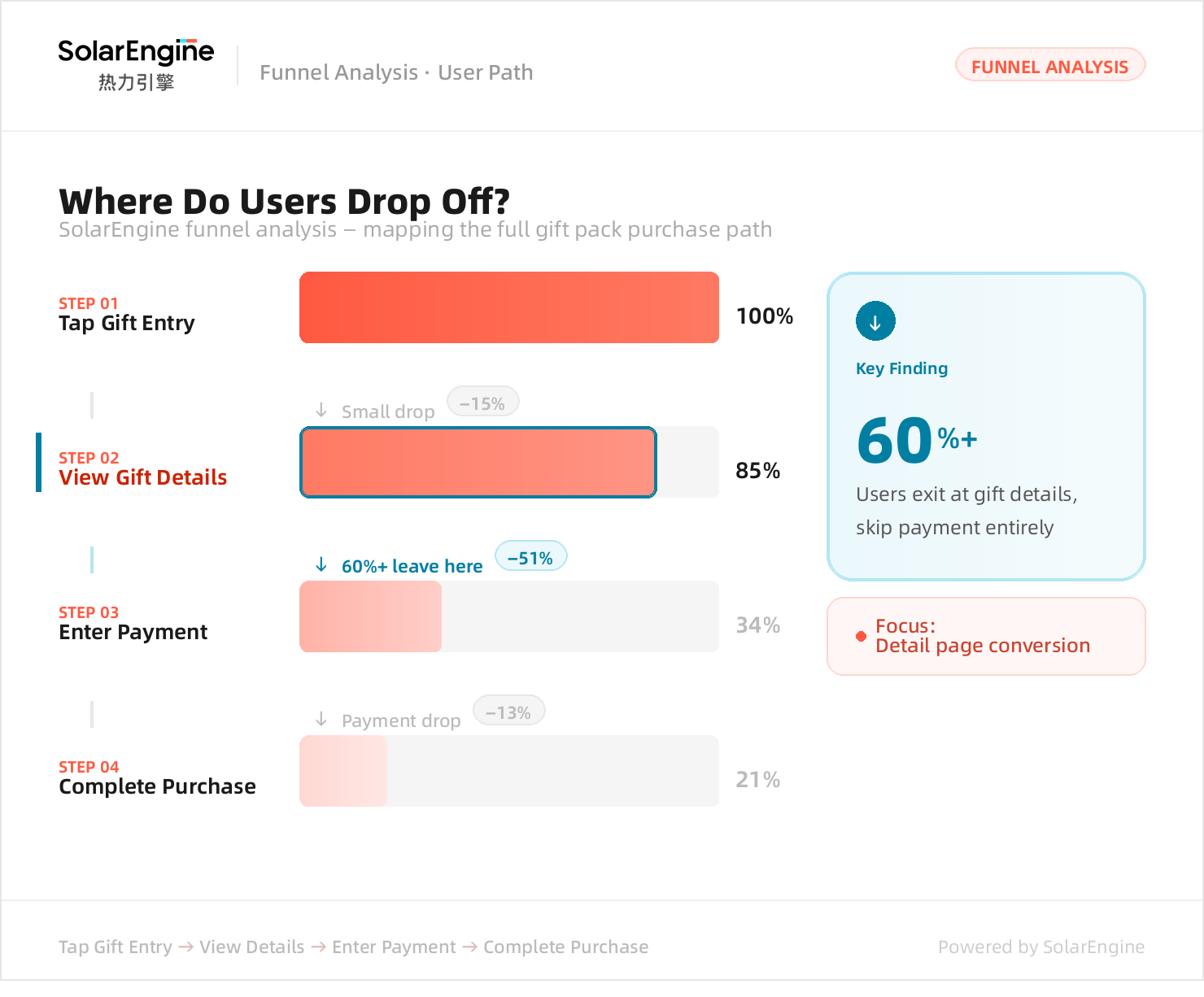
One Southeast Asia-focused RPG saw bundle detail-page views rise to 2.1x the normal level during Eid, but final paid conversion reached only 4.3%, far below the title's usual 11% for similar offers. Using SolarEngine's Funnel Analytics, the team mapped the path: Bundle entry click → bundle detail page → payment page → completed purchase. The biggest drop-off happened on the detail page, where more than 60% of users left before reaching payment.
The reason was clear. The offer did not match the users entering the funnel. Many were low-activity returning players who saw little practical value in limited skin fragments, while Eid spending behavior was driven more by celebration and self-reward than by progression needs. The team then split the offer by segment, launching a 2.90 US dollars starter bundle for lower-activity users and a 19.90 US dollars premium bundle for more engaged players. After the change, combined conversion rose to 9.6%, with stronger overall monetization as well.
What to Track
- Bundle entry clicks
- Detail-page dwell time
- Payment-page reach rate
- Final purchase conversion
If clicks are high but payment-page reach is low, the issue is usually offer fit. If users reach payment but do not convert, the problem is more likely pricing or checkout friction.
Signal 2: Better Timing Can Improve Holiday Conversion Without Changing the Offer
Another common mistake during Eid is assuming that player behavior will follow normal-day patterns or carry over directly from Ramadan. In reality, Eid often works very differently. While Ramadan tends to drive stronger late-night activity, Eid Day 1 is usually shaped by prayers, family visits, and social gatherings, which can make daytime engagement much weaker than expected. For many games, the stronger response window comes later in the evening, and even more clearly on Day 2 and Day 3.
One strategy game team saw this firsthand in Southeast Asia. On Eid Day 1, they sent a bundle push at 9 a.m. Indonesia time. Delivery volume was normal, but the open rate reached only 2.8%, well below the title's usual 6%–8% benchmark. Using SolarEngine's User Behavior Analysis, the team broke activity down by local time and found that login density between 8 a.m. and 12 p.m. on Eid Day 1 was 61% lower than normal, while spending between 9 p.m. and 11 p.m. accounted for 47% of total payments that day. They also found that overall payment conversion on Day 2 was 22% higher than on Day 1.
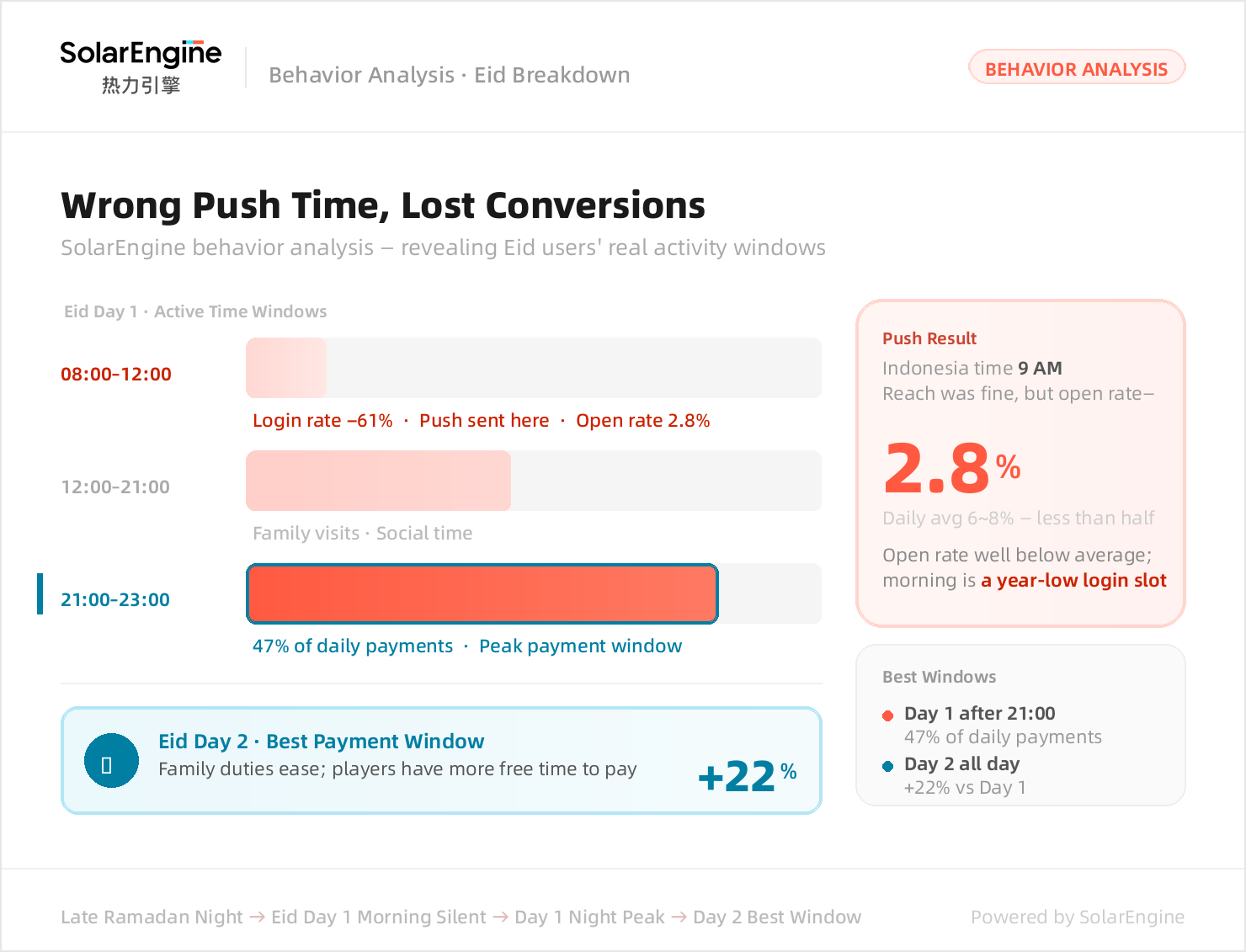
The team adjusted timing rather than changing the bundle itself. On Day 1 morning, they replaced hard-sell pushes with light holiday greetings, then moved the main bundle push to 9 p.m. on Day 1 and followed with another core push on Day 2 morning. With no change to content, bundle open rate rose to 7.4%, and Day 2 sales reached 1.6 times Day 1.
What to Track
- Login density by local hour
- Push open rate by send time
- Payment conversion by time slot
- Revenue contribution by holiday day
If delivery is stable but opens are weak, the issue is often timing rather than messaging. If Day 2 and Day 3 consistently outperform Day 1, campaign weight should be shifted accordingly instead of being concentrated too early.
Signal 3: Strong Holiday Revenue Means Little if Users Don't Stay
Many teams evaluate Eid campaigns based on what happens during the event window: higher DAU, more payers, and stronger short-term revenue. But the real measure of success is what happens after the holiday ends. This is also where holiday performance is most often overestimated.
A common pattern looks strong at first. During a three-day Eid event, DAU may rise by 25% and revenue by 40%. But by Day 7 after the campaign, retention among users activated during the holiday may be only 8%, compared with 19% for natural users acquired in the same period. In other words, many holiday users come for the event, not for the game. If a campaign is built only to drive short-term conversion, it functions more like a temporary promotion than a real growth strategy.
This is also why user mix matters. A data platform has found that remarketing during Eid can convert significantly better than net-new user acquisition. That makes a strong case for focusing more budget on reactivating existing or lapsed users, rather than treating the holiday primarily as a new-user buying window. In many cases, the real value of Eid comes from users your game has already retained, not from traffic acquired at holiday peak.
With SolarEngine's Retention Analytics, teams can build a dedicated holiday cohort of users who first log in or first pay during the Eid window, then compare their Day 1, Day 3, Day 7, and Day 14 retention against a natural-user cohort from the same period. That gap provides a much clearer view of campaign quality than event revenue alone.
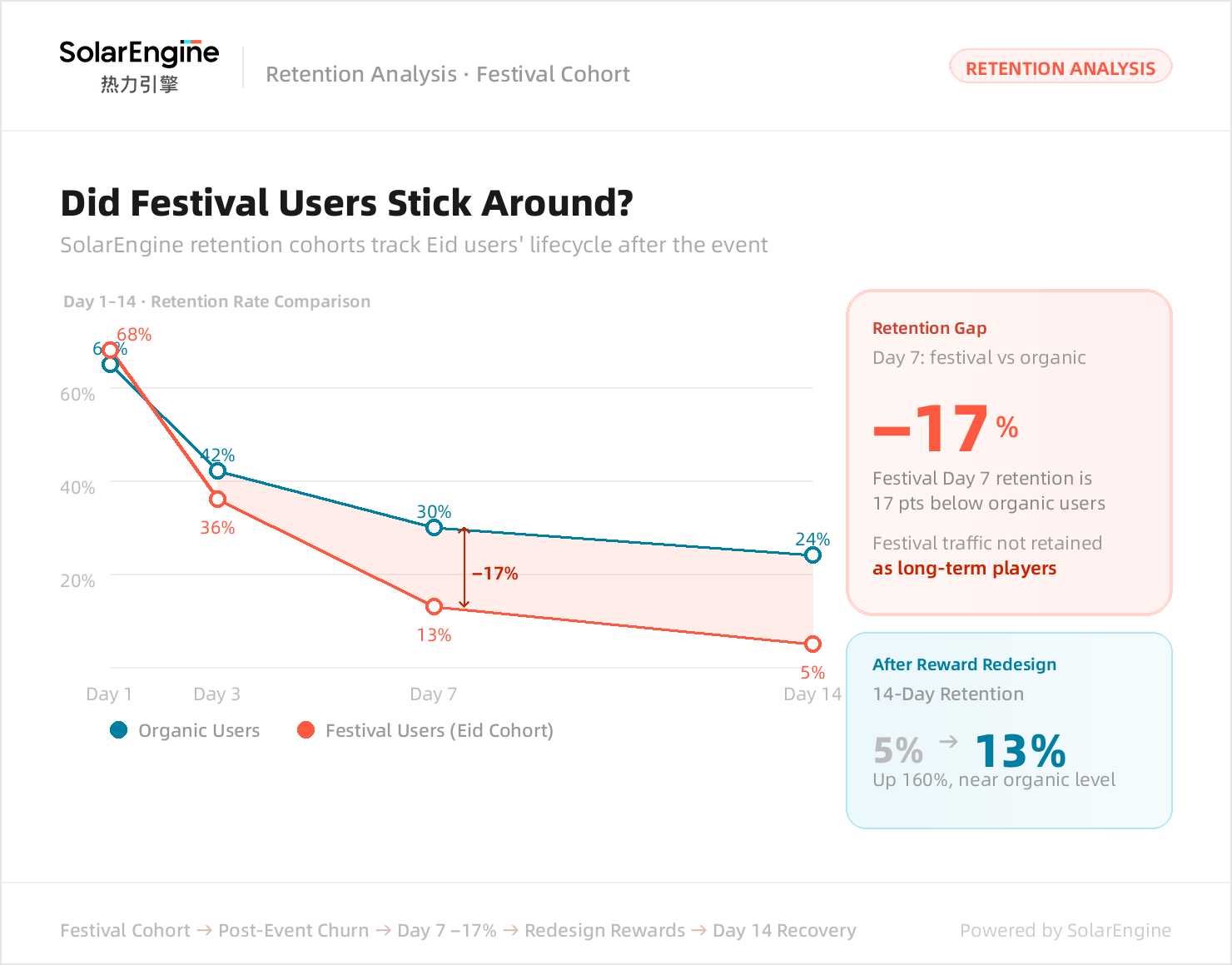
One match-3 game used SolarEngine to compare post-Eid retention across two consecutive years and found that Day 7 retention for holiday users was 17 percentage points lower than for natural users. The reason became clear after a deeper review: the event had delivered a large amount of stamina upfront, which made the three-day holiday experience highly rewarding in the moment, but gave players little reason to return once the event ended. The team later redesigned the reward structure by reducing instant rewards and adding a delayed reward claimable on Day 7 after Eid. After the adjustment, Day 14 retention among holiday-activated users increased from 5% to 13%.
What to Track
- Day 1, Day 3, Day 7, and Day 14 retention for holiday cohorts
- The retention curve compared with natural users
If holiday-user retention is significantly weaker, the first areas to review are whether rewards are disconnected from core gameplay, whether there is enough post-event content to bring users back, and whether remarketing investment is too low.
Putting the Three Signals Together
These three metrics are most useful when viewed together. They show not just whether holiday traffic increased, but where conversion weakened and how much user value remained after the event.
With SolarEngine's Funnel Analysis, teams can see where players drop off between bundle exposure and purchase. User Behavior Analysis helps identify the right engagement windows across markets, time zones, and holiday days. Retention Analysis then shows whether holiday traffic turned into lasting user value by comparing holiday cohorts with natural users after the event.
Eid creates real growth opportunities, but only for teams that measure it carefully. If the tracking framework is in place before the holiday starts, the post-event review becomes much more valuable and much more actionable.
;}.cls-2{fill:%230868f7;}.cls-3{fill:url(%23未命名的渐变_44);}.cls-4{fill:%23333;}%3c/style%3e%3clinearGradient%20id='未命名的渐变_8'%20x1='33.73'%20y1='100.61'%20x2='-0.03'%20y2='-1.06'%20gradientUnits='userSpaceOnUse'%3e%3cstop%20offset='0'%20stop-color='%237ae9fb'/%3e%3cstop%20offset='0.67'%20stop-color='%232b90f8'/%3e%3cstop%20offset='1'%20stop-color='%230868f7'/%3e%3c/linearGradient%3e%3clinearGradient%20id='未命名的渐变_44'%20x1='27.86'%20y1='18.67'%20x2='68.36'%20y2='22.22'%20gradientUnits='userSpaceOnUse'%3e%3cstop%20offset='0'%20stop-color='%235ac7f2'/%3e%3cstop%20offset='1'%20stop-color='%230868f7'/%3e%3c/linearGradient%3e%3c/defs%3e%3cpath%20class='cls-1'%20d='M29,28.74V81.91l-9.51-3.68v0L8.52,74A7.17,7.17,0,0,1,4,67.32V24.54A3.76,3.76,0,0,1,9.08,21Z'/%3e%3cpath%20class='cls-2'%20d='M68.09,78.07a13.15,13.15,0,0,1-17.9,12.06L29,81.91h0V28.74L50.19,37A13.17,13.17,0,0,0,68.08,25.3h0Z'/%3e%3cpath%20class='cls-3'%20d='M68.08,25.3a13.19,13.19,0,0,1-6.73,10.87A13.09,13.09,0,0,1,50.19,37L29,28.74V6A3.76,3.76,0,0,1,34.1,2.52l25.59,9.91A13.22,13.22,0,0,1,68.08,25.3Z'/%3e%3cpath%20class='cls-4'%20d='M129.06,81.76a4.33,4.33,0,0,1-3.19-1.31,4.4,4.4,0,0,1-1.31-3.24V56.86H97.65V77.21a4.36,4.36,0,0,1-1.35,3.2A4.68,4.68,0,0,1,93,81.76a4.32,4.32,0,0,1-3.19-1.31,4.37,4.37,0,0,1-1.32-3.24V27.27A4.58,4.58,0,0,1,89.83,24a4.59,4.59,0,0,1,7.82,3.27V48.15h26.91V27.27A4.58,4.58,0,0,1,125.91,24a4.59,4.59,0,0,1,7.82,3.27V77.21a4.37,4.37,0,0,1-1.36,3.2A4.65,4.65,0,0,1,129.06,81.76Z'/%3e%3cpath%20class='cls-4'%20d='M163.77,81.66c-6.57,0-11.76-1.92-15.44-5.7s-5.54-9.07-5.54-15.74a26.76,26.76,0,0,1,2.09-10.43,17.72,17.72,0,0,1,6.67-8.06,19.15,19.15,0,0,1,10.68-2.95,19,19,0,0,1,10.46,2.8,18.7,18.7,0,0,1,6.55,7.36,22.53,22.53,0,0,1,2.36,10.28A4.51,4.51,0,0,1,177,63.77H152.23a10.8,10.8,0,0,0,3.49,6.65c2,1.68,4.88,2.52,8.66,2.52a22.25,22.25,0,0,0,7.54-1.21c.74-.3,1.55-.67,2.37-1.07a3.75,3.75,0,0,1,1.84-.4,4.09,4.09,0,0,1,3,1.15,4,4,0,0,1,1.12,3,4.38,4.38,0,0,1-2.58,3.82,32.34,32.34,0,0,1-6.36,2.61A28.67,28.67,0,0,1,163.77,81.66ZM172.4,55.9a9.72,9.72,0,0,0-1.63-4.56A9.9,9.9,0,0,0,167,48a10.38,10.38,0,0,0-4.64-1.14,12,12,0,0,0-4.77,1.06,9.54,9.54,0,0,0-4.89,5.66,11.78,11.78,0,0,0-.51,2.3Z'/%3e%3cpath%20class='cls-4'%20d='M193,81.64a4.49,4.49,0,0,1-4.51-4.55V27.28A4.58,4.58,0,0,1,189.84,24a4.48,4.48,0,0,1,3.28-1.36A4.36,4.36,0,0,1,196.35,24a4.46,4.46,0,0,1,1.31,3.31V77.09a4.34,4.34,0,0,1-1.35,3.2A4.67,4.67,0,0,1,193,81.64Z'/%3e%3cpath%20class='cls-4'%20d='M263.79,81.71a5.7,5.7,0,0,1-4.2-1.74,5.76,5.76,0,0,1-1.73-4.19V27.37a4.58,4.58,0,0,1,1.35-3.27A4.59,4.59,0,0,1,267,27.37V72.53h24a4.58,4.58,0,0,1,3.27,7.82A4.66,4.66,0,0,1,291,81.71Z'/%3e%3cpath%20class='cls-4'%20d='M424.48,81.74a4.71,4.71,0,0,1-2.71-.88,5.43,5.43,0,0,1-1-1l-.07-.09-12.41-17-5.41,5v9.44a4.31,4.31,0,0,1-1.36,3.19,4.66,4.66,0,0,1-3.3,1.36A4.29,4.29,0,0,1,395,80.42a4.36,4.36,0,0,1-1.32-3.23V27.37A4.58,4.58,0,0,1,395,24.1a4.52,4.52,0,0,1,6.58.12,4.54,4.54,0,0,1,1.24,3.15V56.31l17.72-16.38.05,0a4.8,4.8,0,0,1,2.94-1.11,4.4,4.4,0,0,1,3.27,1.2,4.57,4.57,0,0,1,1.2,3.27,4.44,4.44,0,0,1-.77,2.33,7.45,7.45,0,0,1-1.43,1.65l-11,9.64,13.34,17.68a5,5,0,0,1,1,2.71,4.12,4.12,0,0,1-1.36,3.24A4.64,4.64,0,0,1,424.48,81.74Z'/%3e%3cpath%20class='cls-4'%20d='M317.93,81.76a21.5,21.5,0,1,1,21.17-21.5A21.37,21.37,0,0,1,317.93,81.76Zm0-34.1a12.61,12.61,0,1,0,12.42,12.6A12.52,12.52,0,0,0,317.93,47.66Z'/%3e%3cpath%20class='cls-4'%20d='M212.18,101.22a4.12,4.12,0,0,1-3.05-1.26,4.17,4.17,0,0,1-1.26-3.1V43.34a4.37,4.37,0,0,1,1.3-3.14,4.26,4.26,0,0,1,3.13-1.3,4.19,4.19,0,0,1,3.1,1.26,4.32,4.32,0,0,1,1.26,3.16,20.77,20.77,0,0,1,13-4.54,21.51,21.51,0,0,1,0,43,20.51,20.51,0,0,1-13-4.57V96.86a4.15,4.15,0,0,1-1.3,3.06A4.5,4.5,0,0,1,212.18,101.22Zm17.43-53.63c-6.23,0-12.93,4.11-12.93,12.72a12.73,12.73,0,0,0,25.46,0A12.71,12.71,0,0,0,229.61,47.59Z'/%3e%3cpath%20class='cls-4'%20d='M365.76,81.76a21.5,21.5,0,1,1,21.18-21.5A21.37,21.37,0,0,1,365.76,81.76Zm0-34.1a12.61,12.61,0,1,0,12.42,12.6A12.52,12.52,0,0,0,365.76,47.66Z'/%3e%3c/svg%3e)