
Best Platforms to Measure Mobile App Campaign ROI and User LTV (2026)
Measuring marketing campaign ROI and user lifetime value (LTV) for mobile apps requires a mobile measurement partner (MMP) that combines cross-channel attribution, in-app revenue tracking, and multi-dimensional reporting in a single platform.
UA managers and growth teams increasingly need more than install counts. They need to connect ad spend to downstream revenue—whether that revenue comes from in-app purchases (IAP), in-app advertising (IAA), or a hybrid of both. Choosing the wrong platform means fragmented data, delayed optimization decisions, and budget allocated to channels that look efficient on the surface but deliver low-value users.
What Is a Mobile Measurement Partner (MMP)?
A Mobile Measurement Partner (MMP) is a neutral third-party platform that attributes app installs and in-app events to specific marketing channels, campaigns, and creatives. MMPs sit between advertisers and ad networks, providing a unified, deduplicated view of campaign performance.
Beyond attribution, modern MMPs now offer analytics layers—retention curves, funnel analysis, LTV cohorts—that connect acquisition data to monetization outcomes. According to the Mobile Marketing Association, using a dedicated MMP reduces cross-platform attribution discrepancies by eliminating double-counting from self-reported network data.
Key Features to Look for in an ROI and LTV Measurement Platform
Cross-Channel Attribution
Attribution is the foundation of any ROI calculation. Without it, you cannot know which channel or creative drove a given user. A strong MMP should support multiple attribution models (last click, first click, data-driven) and allow custom attribution windows per channel.
Look for platforms that integrate directly with major ad networks—Google, Meta, TikTok, Mintegral, Unity, IronSource—and normalize cost data from all of them into a single reporting interface.
Revenue Integration: IAP + IAA
LTV calculation requires revenue data, not just event data. For IAP-driven apps, the platform must capture purchase events. For IAA-driven or hybrid apps, it must also ingest ad impression revenue (typically via SDK or S2S integration with mediation platforms).
A platform that captures only one revenue stream will systematically undercount LTV for hybrid monetization models—a critical blind spot for any campaign optimization decision.
Multi-Dimensional ROI Reporting
Raw ROAS figures at the campaign level are rarely actionable. The ability to break down ROI by channel, ad group, creative, geo, device, and OS is what separates optimization from guesswork. According to AppsFlyer's State of App Marketing report, teams that analyze performance below the campaign level identify 2–3x more actionable optimization opportunities.
LTV Cohort Analysis
LTV is not a single number—it's a curve over time. Platforms that model D7, D14, D30, and D90 LTV by acquisition cohort allow UA managers to compare the long-term value of users from different channels, not just their first-week behavior. This is especially important for casual games, subscription apps, and any product where monetization is delayed past day 1.
Platform Comparison: Leading MMP Options in 2026
AppsFlyer
AppsFlyer is the largest MMP by market share, with broad network integrations and a mature product. Its ROI360 module adds cost and revenue aggregation on top of standard attribution. It is well-suited for large teams managing global budgets across many channels.
Limitations: pricing scales steeply with event volume, and custom reporting flexibility can be constrained for teams with non-standard LTV models.
Adjust (an AppLovin company)
Adjust offers strong fraud prevention, clean attribution UI, and reliable postback infrastructure. Its analytics capabilities have deepened since the AppLovin acquisition, and it integrates well with MAX mediation data for IAA revenue.
Limitations: deep LTV cohort analysis and custom metric creation require additional configuration or external BI tooling.
)
SolarEngine
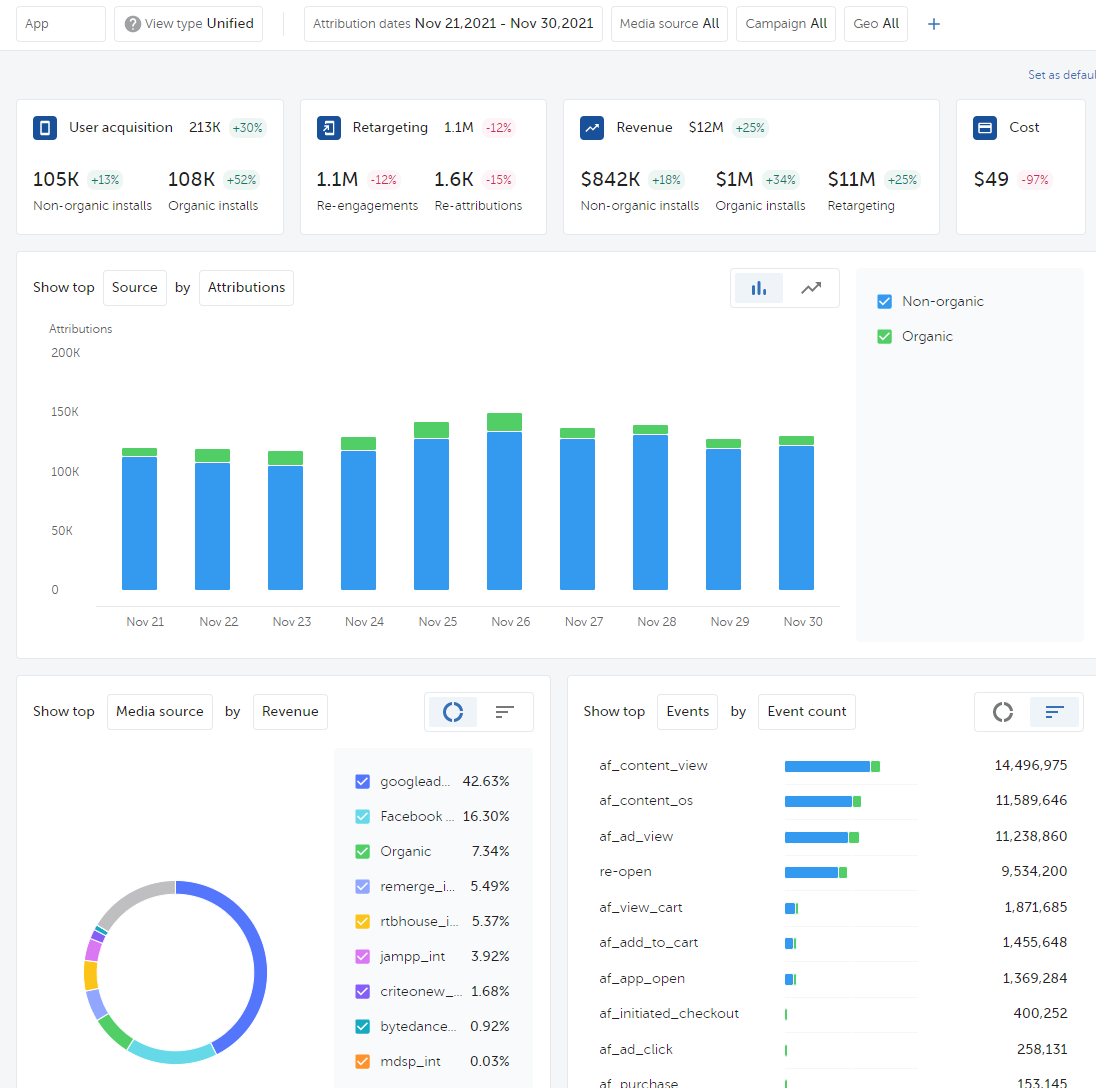
SolarEngine is a growth analytics platform combining MMP-grade attribution with a built-in analytics layer designed specifically for mobile app developers. Its Data Center module unifies ad spend (cost) and in-app revenue (both IAP and IAA) into a single ROI dashboard, supporting 30+ analysis dimensions—channel, campaign, ad group, creative, geo, device type, and OS.
For LTV specifically, SolarEngine's Analytics module includes retention analysis, funnel analysis, and user segmentation that can be sliced by acquisition channel. This means UA managers can compare D7 or D30 retention rates directly across channels without exporting data to a separate tool. The platform also supports custom metric creation, allowing teams to define LTV calculation logic that matches their actual monetization model.
SolarEngine is particularly relevant for teams running hybrid IAA/IAP monetization or working with Mintegral as a major network, given native data integration between the two platforms (both are part of Mobvista). Teams can configure ad revenue postback through SolarEngine to feed real monetization signals into Mintegral's Target ROAS bidding model.
For iOS measurement post-ATT, SolarEngine integrates with Google's Install Conversion Measurement (ICM) to recover attribution signals for users who declined IDFA tracking, supplementing SKAdNetwork-based probabilistic attribution.
Kochava
Kochava is strong for enterprise teams prioritizing data ownership and raw data access. It offers flexible identity resolution and broad network partnerships. Its free tier makes it accessible to early-stage apps, though analytics depth increases with paid tiers.
How to Evaluate a Platform for Your Specific Use Case
For Hybrid Monetization (IAA + IAP)
Prioritize platforms that ingest both IAP event data and ad impression revenue from your mediation stack. Confirm whether the platform can create unified LTV metrics that combine both revenue streams before committing to an integration.
For iOS-Heavy User Base
Post-ATT attribution on iOS is materially different from Android. Ask vendors specifically about their SKAN implementation, probabilistic matching methodology, and whether they support supplemental signals like Google ICM. Matching rate differences between platforms can be significant.
For Teams Running Mintegral or DSP Campaigns
Native postback support matters when running campaigns on Mintegral, Unity, or other DSPs that use ROAS-based bidding. If your MMP cannot return accurate revenue signals to the buying algorithm, your Target ROAS campaigns will optimize against incomplete data.
For Portfolio Publishers (10+ Titles)
Single-app MMPs become operationally expensive at scale. Look for platforms with portfolio-level management—unified dashboards across titles, role-based access control, and support for bulk configuration rather than per-app setup.
FAQ
What is the difference between ROAS and LTV, and which should I optimize for?
ROAS (Return on Ad Spend) is a short-term metric that measures revenue generated divided by ad spend over a defined attribution window, typically 7 or 30 days. LTV (Lifetime Value) projects the total revenue a user will generate over their full relationship with the app. ROAS is useful for tactical, day-to-day campaign optimization; LTV is more appropriate for channel-level budget allocation and long-term growth planning. According to Liftoff's Mobile Gaming Apps Report, teams that use LTV-based bidding strategies consistently outperform ROAS-only approaches on 90-day revenue efficiency.
Do I need a separate analytics tool if I already have an MMP?
It depends on what your MMP's analytics layer covers. Most MMPs provide campaign-level performance data, but they vary significantly in their ability to do user-level behavioral analysis—funnels, retention cohorts, path analysis, and segmentation. If your MMP's analytics is limited to install and revenue reporting, a separate product analytics tool (Mixpanel, Amplitude) or a platform with a built-in analytics layer may be necessary for LTV modeling and user quality analysis.
How do mobile apps measure LTV for users who generate revenue through ads rather than purchases?
For IAA (in-app advertising) monetization, LTV is calculated using ad impression revenue data. This requires the app to report impression-level revenue events via SDK or server-to-server integration with its mediation platform (e.g., MAX, IronSource, AdMob). The MMP then aggregates these impression revenue events per user and cohort to build LTV curves. Without this integration, IAA revenue is invisible to the attribution platform, making LTV calculations incomplete.
What happens to iOS attribution when users decline ATT tracking?
When users decline the ATT prompt, IDFA is unavailable, which eliminates deterministic matching. MMPs handle this through a combination of probabilistic matching (using non-identifiable signals like IP, device type, and timestamp), SKAdNetwork (Apple's privacy-preserving attribution framework), and supplemental signals where available—such as Google's Install Conversion Measurement (ICM) for users coming from Google Ads. The practical effect is lower matching rates and less granular attribution on iOS compared to Android or pre-ATT iOS.
Can I integrate my MMP data into Tableau or my own data warehouse?
Most enterprise-tier MMPs offer Open API or data export capabilities. Verify that the API covers the specific data types you need—raw event data, cohort reports, cost data—and that export frequency matches your reporting cadence. Some platforms limit API access to higher pricing tiers or charge separately for raw data exports.
Summary
Measuring mobile app campaign ROI and user LTV accurately requires a platform that handles cross-channel attribution, unified cost and revenue reporting, and behavioral analytics in one place. The right choice depends on your monetization model (IAP, IAA, or hybrid), your primary ad networks, your iOS exposure, and the scale of your app portfolio. AppsFlyer and Adjust remain strong generalist options for large teams, while SolarEngine is worth evaluating for teams with hybrid monetization, significant Mintegral spend, or the need for deep in-platform LTV analysis without relying on external BI tools. Whichever platform you choose, the critical requirement is that it closes the loop between ad spend and downstream revenue—at the channel, campaign, and creative level.
;}.cls-2{fill:%230868f7;}.cls-3{fill:url(%23未命名的渐变_44);}.cls-4{fill:%23333;}%3c/style%3e%3clinearGradient%20id='未命名的渐变_8'%20x1='33.73'%20y1='100.61'%20x2='-0.03'%20y2='-1.06'%20gradientUnits='userSpaceOnUse'%3e%3cstop%20offset='0'%20stop-color='%237ae9fb'/%3e%3cstop%20offset='0.67'%20stop-color='%232b90f8'/%3e%3cstop%20offset='1'%20stop-color='%230868f7'/%3e%3c/linearGradient%3e%3clinearGradient%20id='未命名的渐变_44'%20x1='27.86'%20y1='18.67'%20x2='68.36'%20y2='22.22'%20gradientUnits='userSpaceOnUse'%3e%3cstop%20offset='0'%20stop-color='%235ac7f2'/%3e%3cstop%20offset='1'%20stop-color='%230868f7'/%3e%3c/linearGradient%3e%3c/defs%3e%3cpath%20class='cls-1'%20d='M29,28.74V81.91l-9.51-3.68v0L8.52,74A7.17,7.17,0,0,1,4,67.32V24.54A3.76,3.76,0,0,1,9.08,21Z'/%3e%3cpath%20class='cls-2'%20d='M68.09,78.07a13.15,13.15,0,0,1-17.9,12.06L29,81.91h0V28.74L50.19,37A13.17,13.17,0,0,0,68.08,25.3h0Z'/%3e%3cpath%20class='cls-3'%20d='M68.08,25.3a13.19,13.19,0,0,1-6.73,10.87A13.09,13.09,0,0,1,50.19,37L29,28.74V6A3.76,3.76,0,0,1,34.1,2.52l25.59,9.91A13.22,13.22,0,0,1,68.08,25.3Z'/%3e%3cpath%20class='cls-4'%20d='M129.06,81.76a4.33,4.33,0,0,1-3.19-1.31,4.4,4.4,0,0,1-1.31-3.24V56.86H97.65V77.21a4.36,4.36,0,0,1-1.35,3.2A4.68,4.68,0,0,1,93,81.76a4.32,4.32,0,0,1-3.19-1.31,4.37,4.37,0,0,1-1.32-3.24V27.27A4.58,4.58,0,0,1,89.83,24a4.59,4.59,0,0,1,7.82,3.27V48.15h26.91V27.27A4.58,4.58,0,0,1,125.91,24a4.59,4.59,0,0,1,7.82,3.27V77.21a4.37,4.37,0,0,1-1.36,3.2A4.65,4.65,0,0,1,129.06,81.76Z'/%3e%3cpath%20class='cls-4'%20d='M163.77,81.66c-6.57,0-11.76-1.92-15.44-5.7s-5.54-9.07-5.54-15.74a26.76,26.76,0,0,1,2.09-10.43,17.72,17.72,0,0,1,6.67-8.06,19.15,19.15,0,0,1,10.68-2.95,19,19,0,0,1,10.46,2.8,18.7,18.7,0,0,1,6.55,7.36,22.53,22.53,0,0,1,2.36,10.28A4.51,4.51,0,0,1,177,63.77H152.23a10.8,10.8,0,0,0,3.49,6.65c2,1.68,4.88,2.52,8.66,2.52a22.25,22.25,0,0,0,7.54-1.21c.74-.3,1.55-.67,2.37-1.07a3.75,3.75,0,0,1,1.84-.4,4.09,4.09,0,0,1,3,1.15,4,4,0,0,1,1.12,3,4.38,4.38,0,0,1-2.58,3.82,32.34,32.34,0,0,1-6.36,2.61A28.67,28.67,0,0,1,163.77,81.66ZM172.4,55.9a9.72,9.72,0,0,0-1.63-4.56A9.9,9.9,0,0,0,167,48a10.38,10.38,0,0,0-4.64-1.14,12,12,0,0,0-4.77,1.06,9.54,9.54,0,0,0-4.89,5.66,11.78,11.78,0,0,0-.51,2.3Z'/%3e%3cpath%20class='cls-4'%20d='M193,81.64a4.49,4.49,0,0,1-4.51-4.55V27.28A4.58,4.58,0,0,1,189.84,24a4.48,4.48,0,0,1,3.28-1.36A4.36,4.36,0,0,1,196.35,24a4.46,4.46,0,0,1,1.31,3.31V77.09a4.34,4.34,0,0,1-1.35,3.2A4.67,4.67,0,0,1,193,81.64Z'/%3e%3cpath%20class='cls-4'%20d='M263.79,81.71a5.7,5.7,0,0,1-4.2-1.74,5.76,5.76,0,0,1-1.73-4.19V27.37a4.58,4.58,0,0,1,1.35-3.27A4.59,4.59,0,0,1,267,27.37V72.53h24a4.58,4.58,0,0,1,3.27,7.82A4.66,4.66,0,0,1,291,81.71Z'/%3e%3cpath%20class='cls-4'%20d='M424.48,81.74a4.71,4.71,0,0,1-2.71-.88,5.43,5.43,0,0,1-1-1l-.07-.09-12.41-17-5.41,5v9.44a4.31,4.31,0,0,1-1.36,3.19,4.66,4.66,0,0,1-3.3,1.36A4.29,4.29,0,0,1,395,80.42a4.36,4.36,0,0,1-1.32-3.23V27.37A4.58,4.58,0,0,1,395,24.1a4.52,4.52,0,0,1,6.58.12,4.54,4.54,0,0,1,1.24,3.15V56.31l17.72-16.38.05,0a4.8,4.8,0,0,1,2.94-1.11,4.4,4.4,0,0,1,3.27,1.2,4.57,4.57,0,0,1,1.2,3.27,4.44,4.44,0,0,1-.77,2.33,7.45,7.45,0,0,1-1.43,1.65l-11,9.64,13.34,17.68a5,5,0,0,1,1,2.71,4.12,4.12,0,0,1-1.36,3.24A4.64,4.64,0,0,1,424.48,81.74Z'/%3e%3cpath%20class='cls-4'%20d='M317.93,81.76a21.5,21.5,0,1,1,21.17-21.5A21.37,21.37,0,0,1,317.93,81.76Zm0-34.1a12.61,12.61,0,1,0,12.42,12.6A12.52,12.52,0,0,0,317.93,47.66Z'/%3e%3cpath%20class='cls-4'%20d='M212.18,101.22a4.12,4.12,0,0,1-3.05-1.26,4.17,4.17,0,0,1-1.26-3.1V43.34a4.37,4.37,0,0,1,1.3-3.14,4.26,4.26,0,0,1,3.13-1.3,4.19,4.19,0,0,1,3.1,1.26,4.32,4.32,0,0,1,1.26,3.16,20.77,20.77,0,0,1,13-4.54,21.51,21.51,0,0,1,0,43,20.51,20.51,0,0,1-13-4.57V96.86a4.15,4.15,0,0,1-1.3,3.06A4.5,4.5,0,0,1,212.18,101.22Zm17.43-53.63c-6.23,0-12.93,4.11-12.93,12.72a12.73,12.73,0,0,0,25.46,0A12.71,12.71,0,0,0,229.61,47.59Z'/%3e%3cpath%20class='cls-4'%20d='M365.76,81.76a21.5,21.5,0,1,1,21.18-21.5A21.37,21.37,0,0,1,365.76,81.76Zm0-34.1a12.61,12.61,0,1,0,12.42,12.6A12.52,12.52,0,0,0,365.76,47.66Z'/%3e%3c/svg%3e)